
Coming to the bottom line, lacrosse, like any sport, is a game of nano-seconds and probabilities. If a goalie has just a nano-second more time, she can make the save. If the goalie sees a right handed attacker dropping their stick below their shoulder, the greatest probability is that the ball will be low and to the goalie’s right side. So, she defends for that.
How does this play out on defense?
The standard training offered to players is to play square to an attacking ball carrier. I call this basketball defense. With this, the defender is reliant on both a left and right side support teammate to shut down an attacker trying to penetrate. It also requires the defender to catch up to the attacker after the attacker makes her move. It reduces the probability of controlling the type of penetration and type of shot we can force the attacker to make. Our defender is on the proverbial island. It also, if we fail, reduces the amount of time our goalie will have to defend the shot, as the attacker will be open to use her strong side. We work long and hard to make this work by reinforcing chatter among teammates and talking about having our heads on swivels. This can work, I agree. Still, we cannot reduce the probabilities because we are totally dependent on the attacker’s actions.
So many moving parts.
How can we reduce the options for the attacker and increase our probabilites of success?
What if we focus on the player’s strong side? Like basketball, every player has a dominant hand and, for most all players up through high school and into college, there is a significant difference between the ability of the dominant and non-dominant hands. Their ability to cradle, pass and shoot is different depending on the side. Let’s play defense on the strong/dominant side: stand on the player’s strong side, do not let the player run toward their strong side, force them to either use their dominant hand in a confined space between their shoulder and your stick (on their side) or use their non-dominant hand to continue. Give our goalie more time with a slower challenged shot.

To train this way, we have to train our defenders on some keys. (for this, let’s assume the attacker is Right hand dominant and starting at the 12 meter or beyond)
- The defender is standing at about a 45 degree angle from the attacker with their right shoulder facing their goalie. They stand off of the dominant side of the attacker so the attacker actually has a solid unencumbered look at the goalie. The farther out the attacker is, the farther to the attacker’s right the defender can go with her chest facing the attacker and their right shoulder facing the goal. The key here is that we do not want to get trapped between the attacker and the goal. This would free up the attacker’s best shot ability.
- The defender’s attitude, standing at the 45 degree angle, should be that the attacker will not get to the field behind her. They will not let the attacker get her dominant hand clear for a shot.
- As the attacker goes to the goal, the defender rides toward her side, not in front of her. Doing this will force either a cramped or deflected shot with the dominant hand or force the attacker to change to the off hand. We want to be on the attacker’s stick, not her body. If we are successful, we have increased the time our goalie will have to respond if the attacker decides to make a challenged or off hand shot.
- If the attacker tries to run directly toward the defender, the defender must backstep toward the sidelines, not the goal. She cannot be caught in front of the attacker and concede the field behind her.
- With this plan, the primary support is almost always coming from the off side defender. They will crash as the attacker gets to the 8 meter. The support on the dominant side of the attacker can shut off any potential pass to another player.
- The next eventuality is the most important for all defenders. When an attacker runs into a problem, there is a very high probability that they will roll out of it and try to continue the attack on their strong side. The natural reaction of defenders is to step toward the sideline, with their back to the goal and try to stay with the defender. They do this because they are defending the path of the attacker. The problem with this is that it has just released the attacker to use their dominant hand if they make it past the defender.
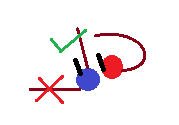
- The correct action for the defender is to step toward the midfield, to get in the path of the attacker as they finish their roll. The result will be a charge, as the defender is already in a set position. Do NOT rotate the hips and step toward the sidelines. Step upfield, so the attacker, as they are rolling somewhat blind, will roll right into the defender.
As a point of success for the defender, if the attacker has had to roll out of the penetration or into a charge or passed the ball or has forced a challenged shot off at the goalie, all of these are successes and should be praised as such. If we can get the players to defend against the attacker’s dominant hand, then we have reduced the attacker’s options and given our goalie a better probability that she can make the save.
There are a lot of drills that can be developed on this and I am happy to go over some.
 Queen City Girls Lacrosse - from the coach's perspective