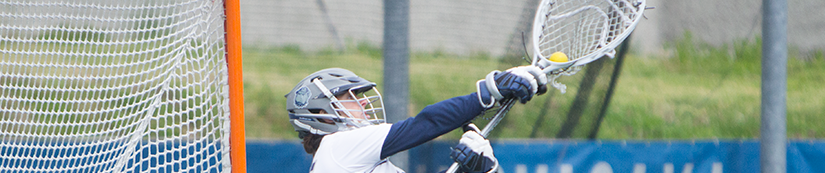
- If you hold tight on the bottom hand and use the top hand to pivot the stick, the face will always be facing the ball.
- If you clamp the stick with your upper hand and try to rotate it across your body or down to your off-side foot, you will see that the face of the stick changes angles toward the ball, leaving you with less surface area and more plastic to make the save.
- The closer your active hand is to the head of the stick, the more energy you will transfer to the pocket, where you are holding the ball. Simple experiment: put a ball in your stick.
- Hold the stick tight with the bottom hand and then hit the stick at the point where the top hand would be holding the stick. The top hand would be the closer/agitator Result: ball will bounce around in the head.
- Hold the stick tight with the top hand and then hit the stick in the same fashion at the point where the bottom hand would be holding the stick: Result: ball will move, but not nearly as much as with the other test.
Reason: you have dampened down the energy on the ball by carrying out all the acts farther away from the head. So, if you jerk up the head with the top hand, you can expect the ball will act completely differently than if you push down on the stick with the bottom hand.
With the bottom hand always clamping on the shaft and having a set distance between where the hand holds and the top of the stick, you will learn to have more control of where you can put the stick to protect the goal. And the face of the stick is always facing the ball.
 Queen City Girls Lacrosse - from the coach's perspective