The majority of coaches teach that a goalie has to have their arms extended out in front of their body. There are some goalies who have been able to learn this and implement it as they grew older. For the earlier years, though, it is very difficult for young players through high school to make this happen with the weight of a goalie stick.
I have just one question: How long can a young goalie hold a lacrosse stick out in front of their body?
This style requires the goalie to use all of her back, shoulder, pectoral and upper arm muscles to ajust to the shot. That is a LOT of muscles and, to make them all get involved, adds time to the goalie’s ability to respond to the shot. Again, micro seconds lost. Then, sometimes I see goalies who hold the stick up only to drop it down when they start reacting to the shot because they are preparing all of these muscles for the response.
SIMPLE AND RELAXED
I have watched a lot of film of Hall of Famer Doc Dougherty. He always looked so calm in the goal. His arms were comfortable and generally hanging just in front of his chest protector. The side of his stick’s head alogside his mask (most of the time in the early years).
I also noted that his controlling hand was always the bottom hand.
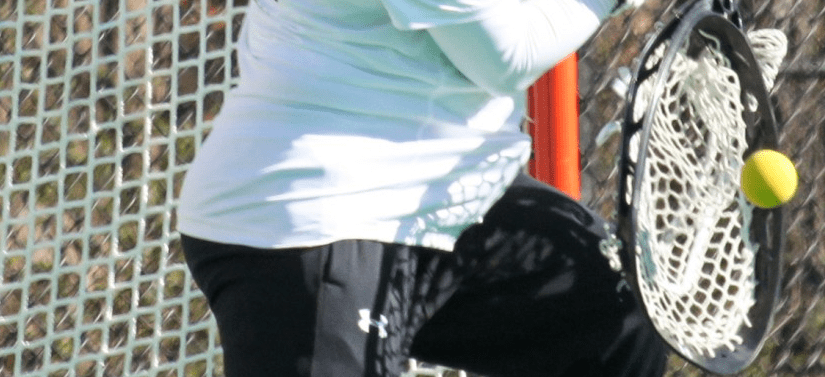
I want to go to the relaxed function of what Doc did in goal (It differs from his instruction in that he wants goalies to EXPLODE their arms out at the ball when a shot is made). The goalies with whom I work make contact with the ball with their arms still bent and near their body. This uses fewer muscles and permits quicker responses to shots as well as fakes. It feels like they are making the saves alongside of their bodies, like an ice hockey goalie making a glove save.It saves micro seconds.
Assumption: the goalie has already put a piece of tape on the stick where she is going to put her bottom hand. It should be, at a maximum, hips distance from the upper hand (at the throat of the stick by the head).
- Goalie holds the stick with the bottom hand on the tape. Upper arms are vertical (not projecting forward). lower arms are parallel to the ground, creating a 90 degree angle at the elbows. Bottom hand grips the stick so that the hand is a little elevated over the wrist and the head of the stick is looking at the sky. The upper hand has the shaft lying across the first row of knuckles (NOT in the palm). The stick is parallel to the goalie’s body and parallel to the ground.
- The goalie lifts the upper hand with the head of the stick so that it is comfortably in front of their shoulder. Their thumb should come up about as high as their chin. The bottom hand can move a little toward the center of the body, but cannot move over to the other side of the body.
The key, at this point, is that the face of the stick is using the grip of the bottom hand to point at the ball. The stick weight is on the elbows and not the shoulders.- By lifting up the upper hand, the goalie has tilted the head of the stick back, so it is in a natural position for the ball to land in the soft mesh and not hit plastic and bounce out.
COACHES: When starting out, always monitor to see that the head is leaning away from the shooter. It does not have to be much, but it has to be leaning back. - The bottom hand can be pushed out a little, but not greatly.
- By lifting up the upper hand, the goalie has tilted the head of the stick back, so it is in a natural position for the ball to land in the soft mesh and not hit plastic and bounce out.
As the goalie is set up with knees bent over the balls of her feet and back straight (not arched forward), her elbows should fall just in front of her chest protector. To do a check on this, get used to tapping the front edges of your chest protector with your elbows. This does two things: 1) keeps your elbows in and down and 2) reminds you to not push your elbows out in front of you (which would raise your stick head, using more muscles).
So, now, after you have read this, I have another question: Which option would you choose?
 Queen City Girls Lacrosse - from the coach's perspective