How can we predict where a shooter is aiming?
Watch the shaft.
Goalies only have a very brief time to react to an attacker’s shot. We are talking milliseconds. Especially if attackers are shooting close to the crease. We teach our goalies to “see the ball” while it is coming out of the pocket.
Goalies work off percentages and probabilities. If an attacker is running in a certain direction, the goalie will expect a higher probability that the attacker will shoot to a certain area of the goal based on their training.
How can we add even more time for the goalie to determine her best probabilities?
WATCH THE LINE OF THE ATTACKER’S SHAFT.
If we train our goalies to focus on the angle of the shafts, then they can create better odds. They can start moving sooner toward the half of the goal where they have a greater probability to make the save. This gives them another millisecond or two to get into a better position.
Here are the three easiest shaft positions to track.

Right Shot 
Left Shot 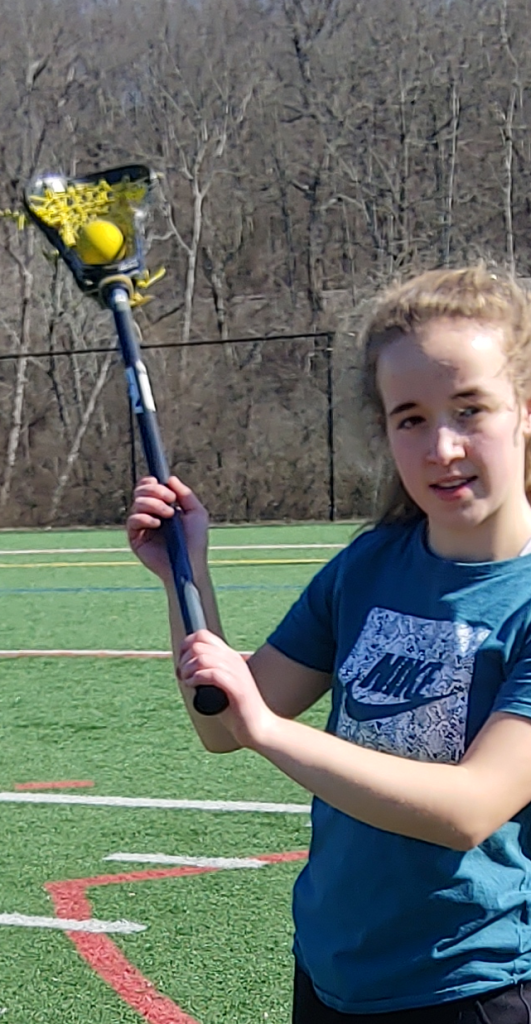
Low/Bounce Shot
Flat versus Long:
First thing we see is that there are two sticks where the shafts are pretty much flat/horizontal. Because the release point on the stick is pretty constant, there is a higher probability that these will be high shots. We want to train our goalies to “see” the line of the shaft to pick up on if the attacker is thinking about shooting to her right or to her left. We can see on these two that there is a very direct target line that our goalie can pick up that gives her a “tell.”
The one long shaft suggests that these are low/bounce shots. Again, the release point on a stick is pretty constant. When an attacker approaches with a long shaft, their shot is more probably going to be a push shot. The top hand will be driving the ball toward the bottom half of the goal. Seeing the long shaft gives our goalie that split second to start lowering her body and rotating her stick head.
Right versus Left:
When shooting, most players’ sticks start off with the butt of their stick effectively pointing at the goal target they are trying to hit. The goalie needs to focus on the shaft as if it were a weather vane, pointing at the source of the wind. In this case, it is pointing at the destination of the shot. Above, we can see what the shaft looks like for both a right and left target shot. With proper training, this will also work for sidearm shots, as the goalie is focusing on the line the stick is following to start their reflex to save.
Good goalie saves are all a function of probabilities and training. The focus is where the MOST shots will be targeted. Shots will go in and goalies will make saves. We train for our goalies to make a reflex decision based on the information they pick up as early in the shot as they can and follow that with their trained reaction. The more they can “buy time” with different “tells,” the greater their save percentage.
 Queen City Girls Lacrosse - from the coach's perspective