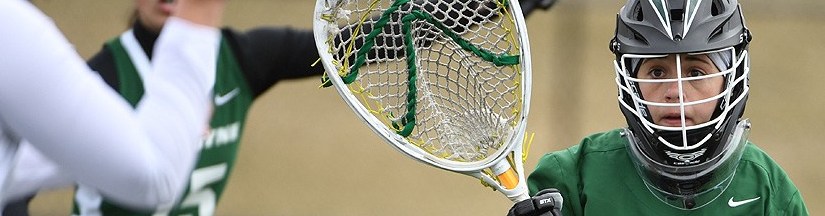
Only stress points for a goalie are the eyes, thighs and bottom hand. Everything else should be aware but relaxed.
Eyes focus on the BALL at all costs! Forget the shooter’s eyes. Only the ball. The goalie’s eyes are always totally focused on the ball and, by extension, the shooter’s stick. Nothing else. As the ball is in the shooter’s stick, the goalie will be able to more quickly determine where the player is putting the ball by watching the ball and the arc of the shooter’s stick.
The goalie’s field of vision should always include the head of her own stick. Without this, it will take the goalie nano-seconds longer to determine where her stick head is and how to make the save.
HAND PLACEMENT
Hands should be separated on the shaft, at a max, as far apart as the goalie’s hips. If they are too wide, you lose control of the ball when it hits. Too narrow and you use more muscles to get to the shot, slowing down your response time and adding nano-seconds.
Top hand should be where the shaft meets the head and be held loose . Keep the hand (catching hand) behind the stick. Thumb and first finger should lightly grip the stick on its sides and point at the ball.
Bottom hand should always be very tight and secure. I advise using tape (create a little mound) to set a position on the stick for the bottom hand. With this, you will innately know the distance between your bottom hand and the top of the stick. The first row of bones on the fingers closest to your palm should be on the front of the shaft facing the ball. It kind of looks like you are going to HIT someone.
Body Set
The knees are always bent to be over the balls of the feet to be able to push up or flex down. The rest of the body should remain relatively loose. The back should be almost straight up and down. You should not lean any farther forward than your knees or toes, as leaning forward puts unnecessary stress on the back muscles, increasing nano-seconds to your save times. Exercises are needed to strengthen the thighs to do this well.
Chest should be square to the ball at all times. If the chest is targeting the ball, the hands will be properly positioned for the save. As the ball comes to the stick, your chest should rotate with the ball. So, if the save is on the left side of the body (for a right handed goalie), your chest will be facing left as needed and you will be stepping out left.
Elbows should be kept hanging below the shoulders no farther forward than the chest protector. Think of it as carrying the weight of the stick on the elbows and not the shoulders. Goalies, in my opinion, do not want to hold their arms and stick out in front of their body, as this uses a lot more muscles, adds stress to the muscles and adds time to your response. You will be using more muscles to get to the shot, which means more time. It will also quickly fatigue younger players, as that stick is not light!
Feet should be a little duck footed and, at a maximum, shoulder distant apart. They should point a little outward. The stance will put pressure on the front of the feet, not on the toes. Your movements will be made in small steps within the goal area. This will set up your chest on the ball until such time as you need to stride out to stop a particular shot. You will need quick, small steps (a little more than shuffling) to cover the 6ft area of the goal.
Shoes: Goalies should use soccer cleats without the center spike on the toes (the center spike decreases the goalie’s ability to rotate).
 Queen City Girls Lacrosse - from the coach's perspective